How to get cited in ChatGPT: a 2026 playbook for B2B tech companies
You get cited in ChatGPT by being the answer the model can trust and extract: earn mentions on the third-party sources ChatGPT actually pulls from (Reddit, Wikipedia, review sites, "best-of" roundups), keep your brand entity consistent everywhere, structure your pages answer-first, and let the right OpenAI crawler in. Your own blog is the smallest lever, not the biggest.
So what: your buyers are already asking ChatGPT for vendor shortlists. If you are not one of the sources it cites, you are not on the list, and you never find out you lost. Getting cited is winnable, but it is a diagnosis problem, not a volume problem. This playbook is scoped to IT, SaaS, cybersecurity, and software companies in the US, and it uses only numbers that trace to a named study with a date.
What changed: ChatGPT went from chatbot to search engine
ChatGPT Search opened to all logged-in users on December 16, 2024 and to everyone, including logged-out users, on February 5, 2025 (OpenAI, "Introducing ChatGPT search," 2024; rollout completed Feb 2025). It now retrieves live web pages and cites a handful of sources per answer, so being "cited" is a real, winnable surface, distinct from ranking in Google.
There are two separate layers, and the rest of this playbook depends on telling them apart:
- The training layer. What the model absorbed from the web up to its cutoff. This is where long-game brand recognition lives. It is slow to move and you cannot edit it directly.
- The retrieval layer. What ChatGPT fetches live when it runs a search to answer a query. This is where citations are won today, in weeks-to-months, not in a single training cycle.
Almost every competing guide blurs these two. Keep them apart and most of the confusing advice you have read sorts itself out.
How does ChatGPT pick which sources to cite?
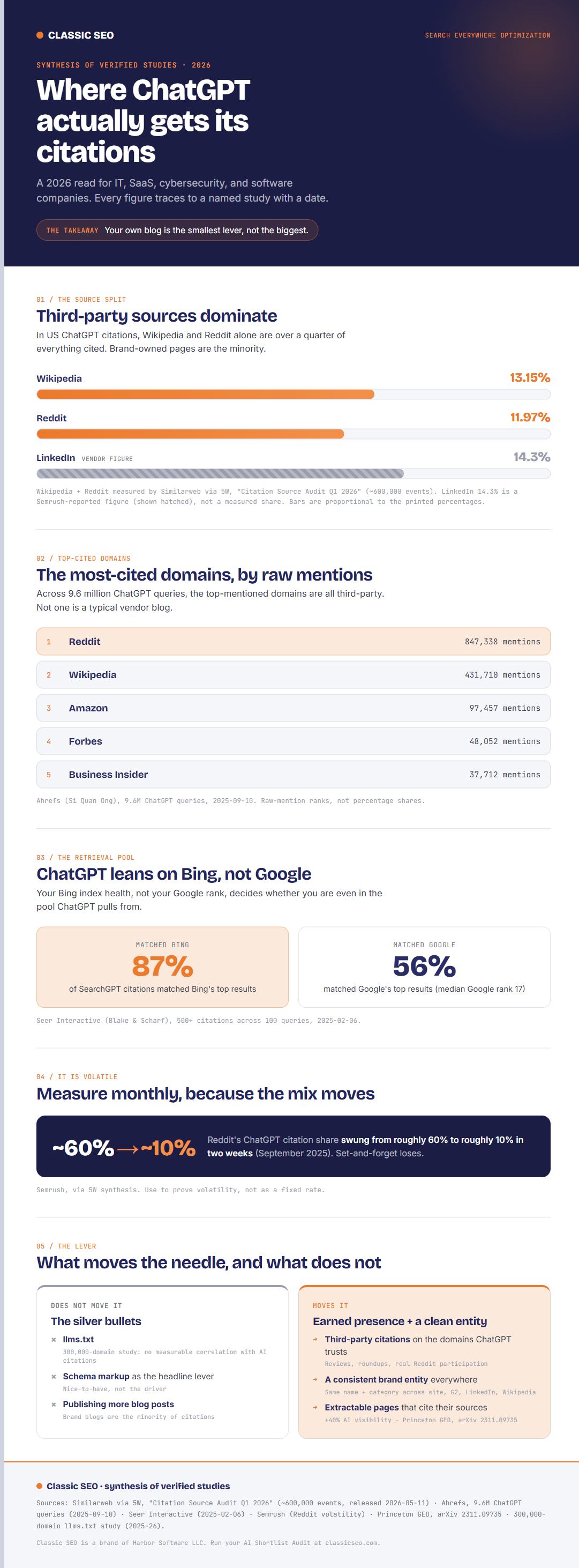
ChatGPT's retrieval pool leans heavily on Bing, then the model favors content that answers the query near the top and comes from sources it already trusts. In Seer Interactive's study, 87% of SearchGPT citations matched Bing's top organic results, versus 56% for Google, where the median matching result sat at rank 17 (Seer Interactive, Blake and Scharf, 500+ citations across 100 queries, February 6, 2025).
So what: your Bing index health and your presence on already-trusted third-party domains decide whether you are even in the retrieval pool. Your Google rank does not transfer the way most teams assume.
Does ChatGPT use Google or Bing?
Bing is the documented baseline. As of the Seer study (February 6, 2025), SearchGPT citations matched Bing far more than Google. OpenAI has broadened its sourcing since, but the Bing dependence is the measured starting point, which is why Bing indexing and IndexNow submission matter more than people expect.
Training vs retrieval: which one gets you cited today?
Retrieval gets you cited today. Retrieval runs through OAI-SearchBot and live page fetches, so a page that is indexable, answer-first, and on a trusted domain can be surfaced quickly. Training is the long game: it builds the brand-to-category association the model recalls without searching, but it only updates on OpenAI's refresh cycle, so you cannot treat it as this quarter's lever.
Methodology box: how we checked this
What this article does. It synthesizes published studies that each trace to a named source with a date: Seer Interactive (Bing match, Feb 6, 2025), Ahrefs (100 most-cited domains, 9.6M queries, Sep 10, 2025), Similarweb via 5W (Q1 2026 citation source audit, ~600,000 events, released May 11, 2026), Semrush (LinkedIn share and Reddit volatility), and OpenAI's own crawler documentation.
What it deliberately leaves out. Precise-sounding numbers that no buyer can verify. A large share of the "how to get cited" field quotes figures with no traceable method. We cite only numbers with a named study and a date, and we flag where a number is a vendor's self-report rather than a measured result.
What it does NOT do. It does not run a live, multi-engine prompt benchmark for your specific brand. Recording exactly which sources ChatGPT cites for your buyers' prompts requires a real prompt-run against your category. That is what the AI Shortlist Audit delivers, and it is the one thing desk research cannot give you.
Which sources does ChatGPT actually cite?
ChatGPT cites third-party sources far more than brand-owned pages. In US ChatGPT citations, Wikipedia (13.15%) and Reddit (11.97%) alone account for over a quarter of all citations (Similarweb via 5W, "Citation Source Audit Q1 2026," ~600,000 events, released May 11, 2026). Ahrefs' larger study, covering 9.6M ChatGPT queries, ranks Reddit, Wikipedia, Amazon, Forbes, and Business Insider as the top raw-mention domains (Ahrefs, Si Quan Ong, September 10, 2025).
So what: if your strategy is "publish more blog posts," you are investing in the smallest slice of where citations come from. The leverage is on the third-party domains the model already trusts.
The table below is Classic SEO's synthesis of the verified studies, plus a row for the ICP-scoped benchmark we run for clients. We do not estimate it from desk research, we measure it: a real prompt-run against your buyers' B2B-tech questions, which is exactly the AI Shortlist Audit in action.
| Source type | Citation signal (verified) | What a B2B-tech brand does about it |
|---|---|---|
| Community (Reddit, forums) | Reddit is a top-cited domain in both the Ahrefs 9.6M-query study (2025-09-10) and the Similarweb/5W Q1 2026 audit (Reddit 11.97%) | Participate authentically where your buyers already discuss the category. Real answers, never astroturf. |
| Reference (Wikipedia) | Wikipedia 13.15% of US ChatGPT citations (Similarweb/5W, Q1 2026); second-highest raw mentions in Ahrefs (431,710) | Keep any Wikipedia entry accurate and current. Earn the notability that justifies one if you do not have it. |
| Review aggregators (G2, Capterra, TrustRadius) | The verified studies show citations concentrate on third-party trust domains over brand blogs (Ahrefs 2025-09-10; Similarweb/5W Q1 2026) | Build review volume and recency on the platforms your category uses. This is direct entity and trust evidence. |
| Editorial roundups / "best-of" listicles | Listicles and comparison content are consistently among the most-cited formats across the verified domain studies | Get into the roundups and comparison articles editors publish for your category. Highest-leverage placement. |
| Business / professional (LinkedIn) | LinkedIn cited in 14.3% of ChatGPT Search responses, 325,000 prompts (Semrush reports, via Similarweb/5W synthesis) | Maintain a consistent, category-clear company presence. Treat the 14.3% as a vendor figure, not gospel. |
| Vendor's own site | Present but the minority share across every verified study; brand blogs are not where most citations come from | Make your pages extractable so you capture the share that does exist. Do not expect it to carry the strategy. |
| B2B-tech ChatGPT benchmark (Classic SEO, ICP-scoped) | The live source-type split for your category, measured by running about 25 of your buyers' real prompts through ChatGPT. Delivered as the AI Shortlist Audit, not a desk estimate. | This is the audit. We run your buyers' prompts and report which source types ChatGPT cited instead of you. |
Where ChatGPT citations actually come from
How to get cited in ChatGPT, step by step
- Map the prompts your buyers actually ask. Not your keywords, the real questions: "best [category] for [use case]," "[your brand] vs [competitor]," "is [your brand] any good." This list is the input to everything else.
- Find out who ChatGPT cites instead of you. Run those prompts in ChatGPT Search and record every cited URL and its source type. You are looking for the pattern, which source types win for your category, not a single answer.
- Fix your brand entity first. Use an identical name, category, one-line description, and differentiators across your site, G2, Capterra, TrustRadius, LinkedIn, and Wikipedia. Consistency before volume. If the model cannot categorize you confidently, it will not shortlist you confidently.
- Earn the third-party citations ChatGPT trusts. Get into "best-of" roundups and comparison articles, build review volume and recency, and participate authentically in the Reddit and community threads your buyers read. This is the biggest lever, and the verified domain studies are why.
- Make your own pages extractable. Lead each section with a direct, 40-to-60-word answer, use comparison tables for "X vs Y," add an FAQ, name your author, and show a visible last-updated date. Citing your own sources is worth a meaningful visibility lift on its own (Princeton GEO research, +40% from citations, arXiv 2311.09735).
- Let the right crawler in. Do not block OAI-SearchBot, which governs ChatGPT Search surfacing, or ChatGPT-User, the user-initiated fetch (OpenAI developer docs). GPTBot is training-only, so allowing it is about future training data, not live-search citation. Index in Bing and submit changes via IndexNow.
- Measure share of model and repeat. Track monthly. The field is volatile: Reddit's ChatGPT citation share swung from roughly 60% to roughly 10% in two weeks in September 2025 (Semrush, via 5W synthesis). Set-and-forget loses.
For the version of this playbook that covers every engine at once, not just ChatGPT, see our guide on how to get cited by AI search engines.
Why does ChatGPT recommend my competitor and not me?
Usually because your competitor has stronger entity recognition and shows up on the third-party sources ChatGPT trusts, not because they have better SEO. The model is recalling and retrieving a category association you have not earned yet. The common mistakes that cause it:
- Treating it as a content-volume problem. Publishing more blog posts the model does not cite. The verified studies show brand blogs are the minority of citations.
- Investing only in Google SEO and assuming it transfers. It largely does not. ChatGPT's retrieval leans on Bing (Seer, Feb 6, 2025) and on third-party trust, not your Google position.
- Blocking the wrong bot, or blocking OAI-SearchBot by accident. A misconfigured robots.txt can quietly remove you from ChatGPT Search eligibility entirely.
- An inconsistent brand entity across G2, LinkedIn, and your own site, so the model cannot categorize you with confidence.
- Buying or selling llms.txt or schema as the citation silver bullet. It is not the lever (see the next section).
- No measurement, so you never see the volatility or learn what is actually moving.
If you are specifically a SaaS company, the vertical version of this with persona-level detail is AI SEO for SaaS.
Do schema, llms.txt, or robots.txt tweaks get you cited?
Mostly no, not as the headline lever. Schema and llms.txt are nice-to-have. One 300,000-domain study found no measurable correlation between llms.txt and AI citations or rankings (reported via SE Ranking and others, 2025-2026). The robots.txt point that does matter is the one most guides get backwards: keep OAI-SearchBot and ChatGPT-User allowed, because those govern whether ChatGPT can surface and fetch your pages at all.
The correct platform facts, from OpenAI's own crawler documentation:
- OAI-SearchBot surfaces sites in ChatGPT Search. This is the one to keep open for citation.
- GPTBot is training-only. Allowing it shapes future training data, not live-search citation.
- ChatGPT-User is the user-initiated fetch, triggered when a user asks ChatGPT to look at a page.
Do not follow advice that tells you to "allow GPTBot to get cited in ChatGPT Search." That conflates the training crawler with the search crawler and misses the bot that actually matters.
Related
Closely related concepts and tools worth knowing: Generative Engine Optimization (GEO), Answer Engine Optimization (AEO), share of model, the AI Shortlist Audit, and the engines themselves: ChatGPT Search, Perplexity, Google AI Overviews, Gemini, and Bing Copilot. For the all-engines playbook, start with the cluster hub on getting cited by AI search engines; for the SaaS-specific version, see AI SEO for SaaS.
Want to know which prompts your buyers ask, and who ChatGPT cites instead of you? That is exactly what the AI Shortlist Audit (from $750 USD) delivers: we map your buyers' real prompts, run them, and show you the source-type gaps to close. Start with the free AI Shortlist Snapshot if you want the low-friction first look.
Frequently asked questions
How long does it take to get cited in ChatGPT?
Months, not weeks. Retrieval-based engines like Perplexity move faster because they re-fetch the live web. ChatGPT lags more because part of its behavior depends on training refreshes you cannot schedule. Plan for a few months of compounding earned presence, not a one-week fix.
Does blocking GPTBot stop ChatGPT from citing me?
Not by itself. GPTBot is the training crawler. The crawler that governs ChatGPT Search surfacing is OAI-SearchBot, and ChatGPT-User handles user-triggered fetches (OpenAI developer docs). If citation is your goal, the bot to keep open is OAI-SearchBot, not GPTBot.
Is getting cited in ChatGPT different from ranking in Google?
Yes. Cited is not the same as ranked. ChatGPT leans on Bing's results and on third-party trust signals rather than your Google position. In Seer's study, 87% of SearchGPT citations matched Bing's top results versus 56% for Google. You can be cited in ChatGPT while ranking on page two in Google, and the reverse.
Can I guarantee a ChatGPT citation?
No. The field is volatile and no provider can guarantee a citation. Reddit's ChatGPT citation share alone swung from roughly 60% to roughly 10% in two weeks (Semrush, September 2025). What you can do is raise your probability and grow your share of model over time.
How do I check if my brand is cited in ChatGPT?
Run your real buyer prompts in ChatGPT Search monthly and record who gets cited, or use a share-of-model tool such as Ahrefs Brand Radar, Otterly, or Peec for citation tracking and sentiment. The manual prompt panel is free and exact; the tools scale it and add trend lines.
Does ChatGPT cite my own website?
Rarely as the main source. Across every verified study, most citations are third-party: Wikipedia, Reddit, review sites, and editorial roundups. Your earned presence matters far more than your blog, which is why entity clarity and third-party citation density are the priorities.